Open Strings · Find chords
Finding chords
Five ways in, from "just give me something" to "show me what this tuning can do". Every card works the same: click it to hear it on the neck, press + to add it to the loop.
Swapping
Select a chord in the loop first and every card on this page drops into that slot instead of being added at the end. The line at the top of the panel then suggests chords over the same bass note and chords that keep two of its notes: the swaps that sound smoothest. Esc when you're done.
Start here · loops to play
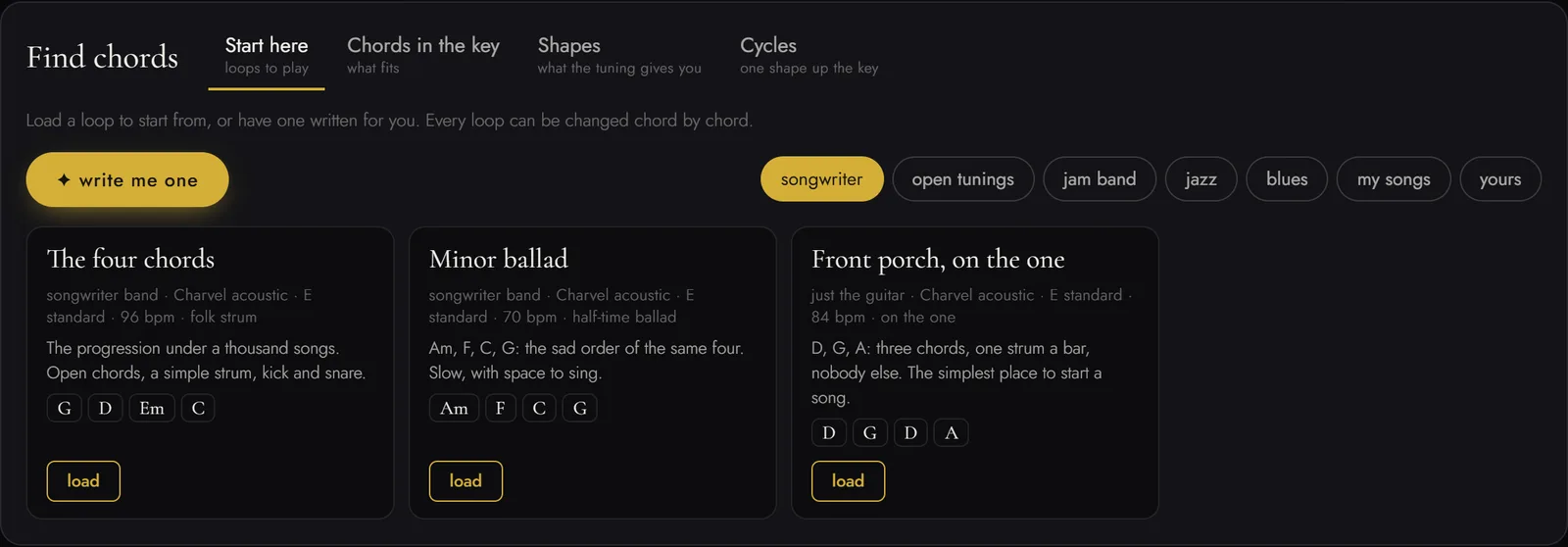
Starters are loops I've set up, grouped by what you want to play: songwriter, open tunings, jam band, jazz, blues, and my songs (Four Quarters and The Sun Is Coming, with their sections and form). Press load and it sets up everything: your loop, the guitar and tuning, the band, the feel, the tempo and the swing. Press Space and it already sounds right; there's nothing to open in fine-tune unless you want to.
Yours holds every loop you've kept with keep it.
✦ write me one or N writes a new progression for the guitar and tuning you're on, voiced to sit under the hand. A short note under the loop says what it did.
Chords in the key · what fits
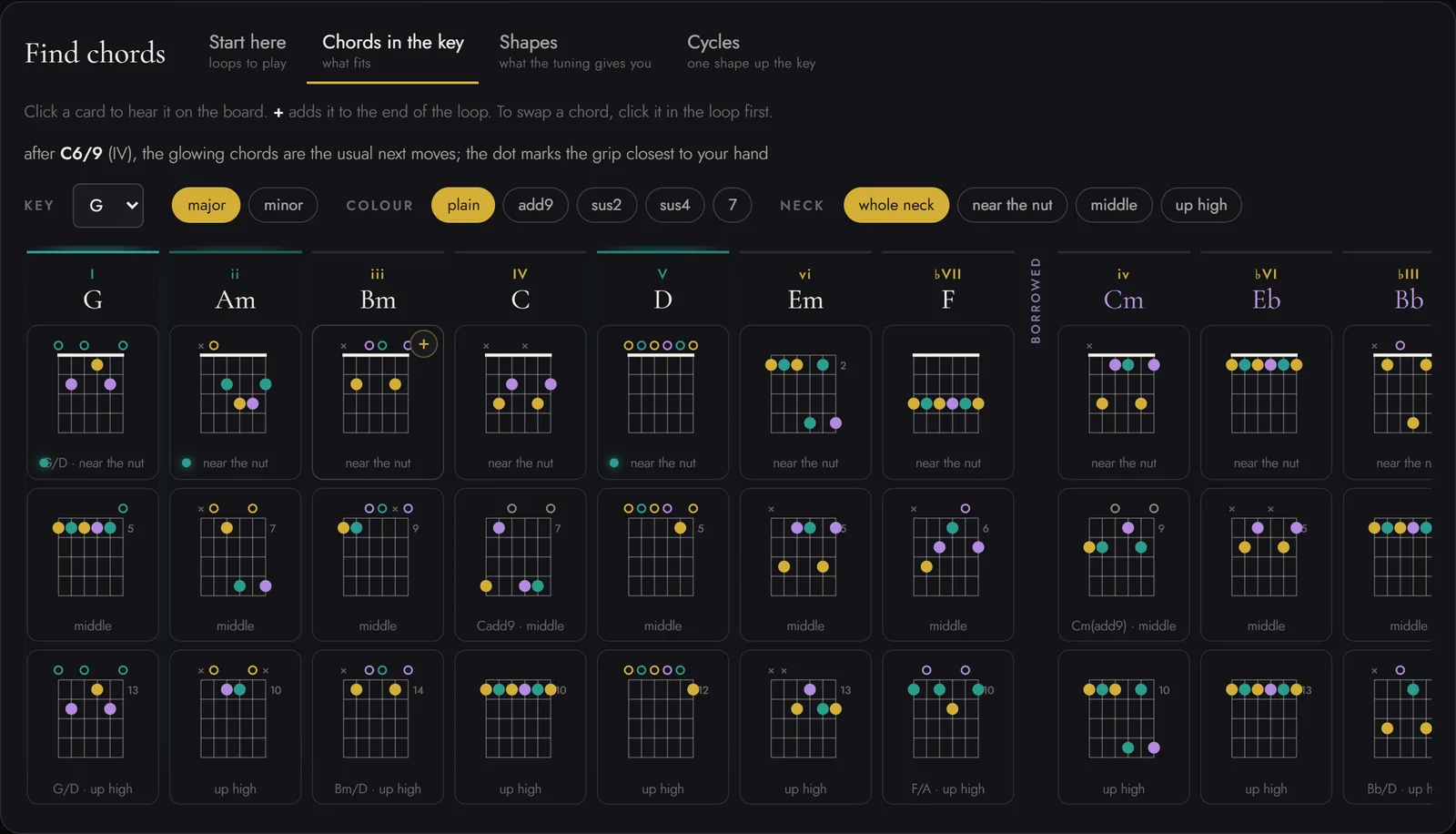
The key's chords laid out as columns, I through ♭VII, each with every grip for that chord the tuning gives you. Further right, past the borrowed line, are chords from the parallel key (in a major key: iv, ♭VI, ♭III). They're the sound of a lot of open-tuning music.
- Glowing columns are the usual next moves after the chord you're on. The brighter, the more common.
- The dot marks the grip closest to where your hand already is.
- Colour pills turn every chord into its plain, add9, sus2, sus4 or 7 version.
- Neck pills keep the grips to one part of the neck: near the nut, the middle, up high.
Shapes · what the tuning gives you
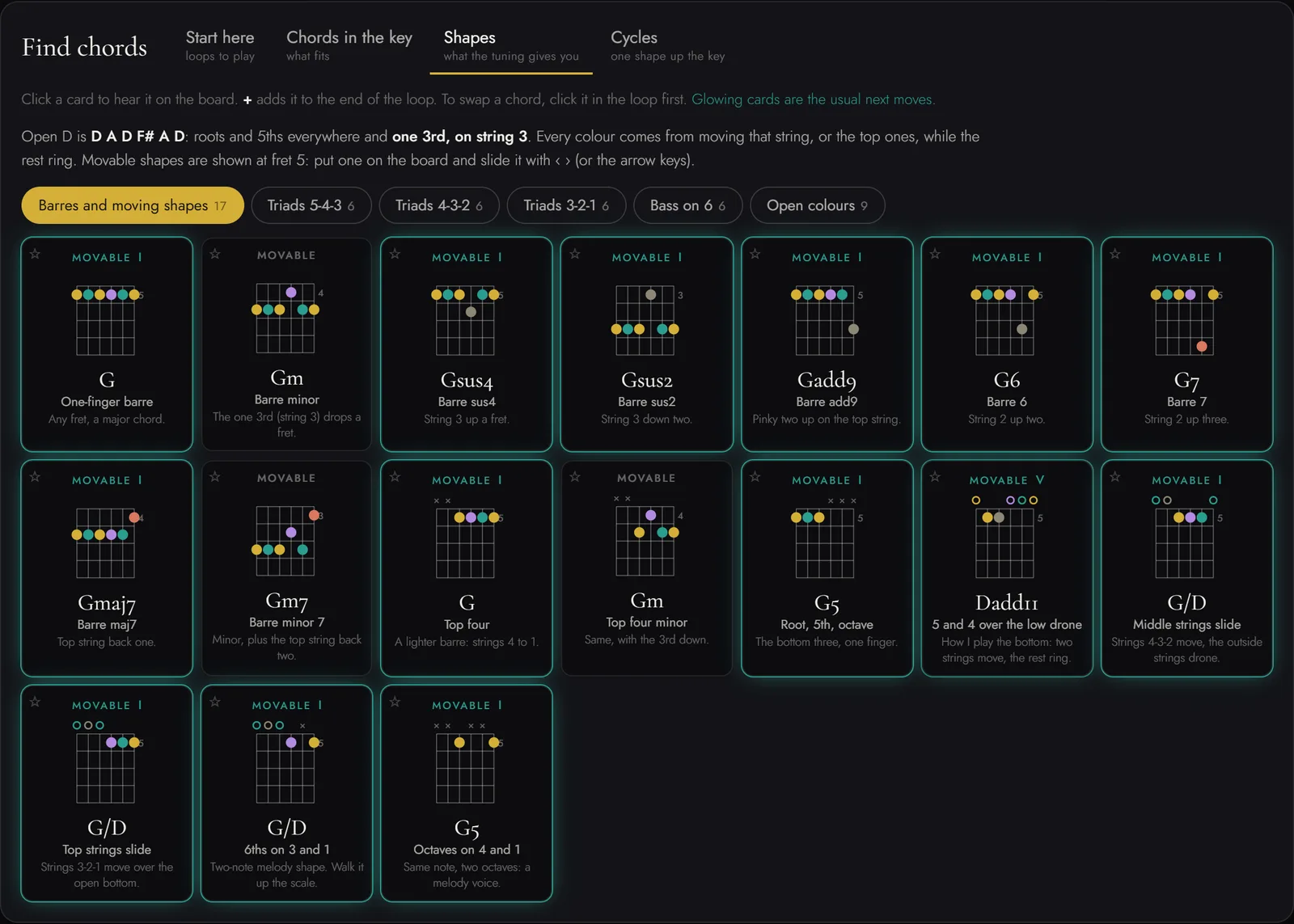
The grips that make each tuning what it is. The note at the top tells you the tuning's strings and which one string holds the 3rd. Most shapes are movable: they're shown at fret 5, so put one on the neck and slide it with ‹ fret › or the arrow keys, and the name follows.
In the open tunings you get one-finger barres (and what one more finger turns them into), shapes where only two or three strings move over a ringing drone, triads on each set of three strings, and two-note melody shapes like 6ths and octaves. In standard tuning it's the movable barres and the big open chords. On the bass, the grips under every bass line.
The pills along the top split them into groups (in Open D: barres and moving shapes, triads on 5-4-3, 4-3-2 and 3-2-1, bass on 6, open colours). Press ☆ on a card to star it: starred shapes get their own group, so your favourites are one click away.
Cycles · one shape up the key
My favourite way to find something new. Pick a small shape, one to three fingers with the other strings ringing. The cycle walks it up the key: at each position every finger moves to the next note of the key, so the shape keeps changing but always fits. After seven positions it starts over twelve frets up.
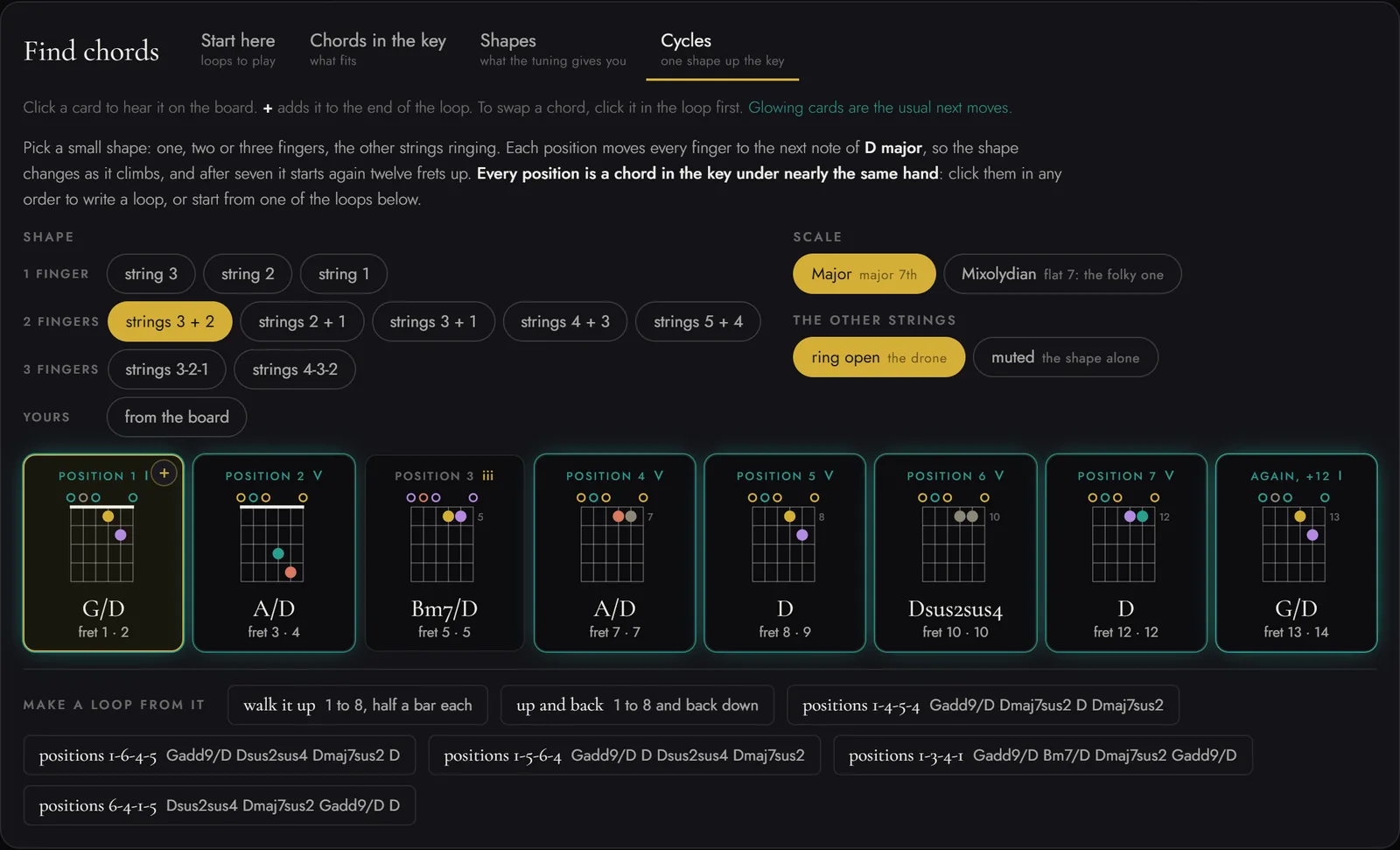
Choose the shape by how many fingers and which strings, or from the board to cycle whatever you're holding. Scale picks plain major or Mixolydian (a flat 7th: the folky one), and the other strings either ring open as a drone or are muted so you hear the shape alone.
Click positions to hear them. Make a loop from it turns a run of positions (1-2-3-4, up to 8 and back down, and so on) straight into a loop.
Go find some →